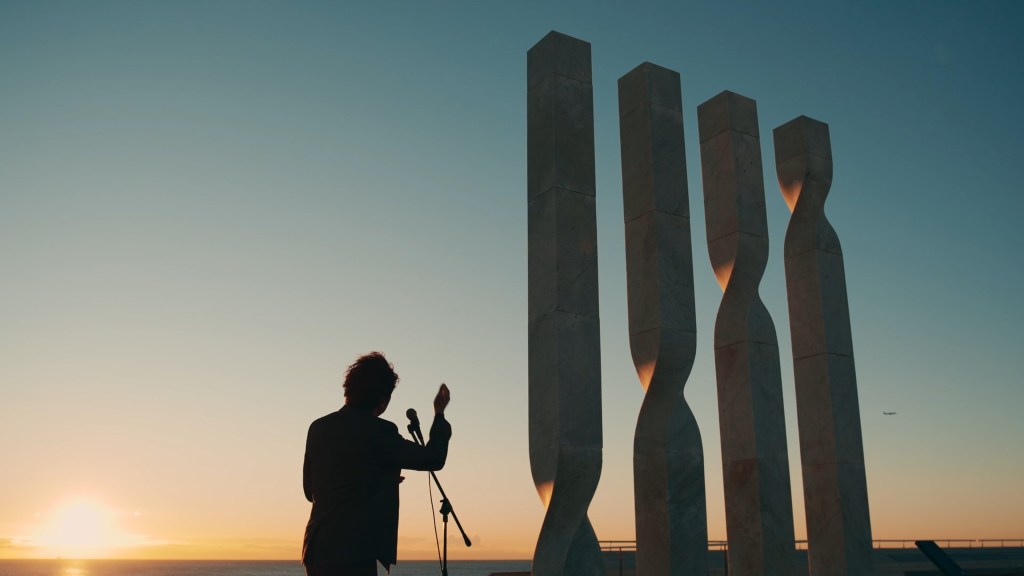
There is a moment in Artificial Ruins where a man drowns on a shrimp while another sets himself on fire reciting Shakespeare, and a vegan actress observes everything with the algorithmic indifference of a ChatGPT evaluating karma. This is not (only) cinema. It is a real-time autopsy of what it means to create when creation itself has become artificial.
Artificial Ruins is my first feature film. A film about people making a film. About a woman who writes people who come to life. A narrative Chinese box where each level of reality discovers that it is, in turn, fiction. Metafiction for the end of times. The film that asks you: “What happens when the film you’re making starts to make you?”
This is the question that beats in the delirious heart of Artificial Ruins.
The Toxic Amateur Hour
A group of amateur filmmakers—because we are all amateurs now, we are all playing at making art with the remains of cultural shipwreck—embarks on an experimental project that progressively destroys them. Not metaphorically. Literally.
Led by Matthew, an American consultant with multiple personalities (half agile entrepreneur, half delirious chef), the team represents each toxic archetype of independent cinema: the screenwriter who cannot write without AI, the shamanic actress who confuses rituals with acting, the producer who wants to replace humans with digital avatars, the DJ influencer whose only depth is the abyss that stares back at him.
They are pathetic. They are absurd. They are… us.
The Border That Never Existed
What begins as chaotic filming transforms into something darker, more real and yet impossible. The border between the fiction they film and the reality they inhabit dissolves like sugar in acid. Spaces mutate: the corporate meeting room accumulates sleeping homeless people; the set illuminates with the phosphorescent colors of a reggaeton music video.
Within the film they make, The Writer, imprisoned in a minimalist room dominated by a black monolith, attempts to write characters so detailed they can exist in the physical world. Her creations are satires of current digital culture: a Victorian Reggaeton Superhero, a revolutionary TikToker, a Scrum & Yoga Master, a Housewife who manufactures sausages from human meat. Hallucinations of late capitalism turned to flesh and bone.
When she finally manages to create a complete human being, The Creation, a beautiful blonde woman, she must make a pact with the monolith: life in exchange for absolute adoration. But the true revelation comes afterward.
The Collapse
The final collapse is operatic in its violence and absurd in its sincerity. There is a nihilistic soliloquy on the creative superiority of machines over humans. A plastic axe. A director-satyr pursuing one of his actresses. Fade to black.
The Ghosts That Haunt Me
This film would not exist without the phantoms that inhabit me: Reservoir Dogs for its violence contained in a single space; Mulholland Drive for teaching me that reality is negotiable; 8½ for showing me that the blocked artist is the hero of our epoch; Birdman for its existential claustrophobia; Dogville for proving that the artificiality of a set can be more real than any location.
And Charlie Kaufman. That filmmaker who understands that metafiction is not a trick but a form of brutal honesty. Synecdoche, New York is the genetic map of Artificial Ruins: the artist who builds worlds that collapse upon themselves, the invisible line between life and representation, the apocalypse as the only honest ending.
And Fellini, of course. For teaching me that the grotesque can be tender, that the circus of art deserves to be filmed with love even when everything is burning. For showing me that cinema can be both a mirror and a funhouse.
Why Now, Why This
We live in the era of infinite creation and (nearly) empty meaning. Anyone can make a film, write a book, record a song. The tools are democratized. The problem is that we no longer know why we create. We optimize for metrics, algorithms, virality. We make content, not art. We build artificial ruins.
Artificial Ruins is my response to this nightmare: a film about the impossibility of making cinema when cinema has become content, when AI can write screenplays faster than we can, when every frame is pre-optimized for the infinite scroll. It is a desperate film, furious, conscious of its own futility. But it is also a film that refuses to die in silence.
Authenticity as the Final Frontier
If there is something I rescue from this delirious project, it is this: when everything is artificial—our digital identities, our relationships mediated by screens, our desires algorithmically generated—the only authentic thing we have left is to recognize our artificiality. Not as defeat, but as liberation.
The characters of Artificial Ruins are constructions. They know it. We know it. And in that mutual recognition, in that complicity between fiction and spectator, there is something genuinely human: the capacity to create meaning even when we know that meaning is a mere illusion we keep alive with simple force of will.
As The Creation says before departing: “We will see each other again, won’t we?”
And The Writer responds: “In every dream you can’t remember.”
(It’s not true, she doesn’t say that.)
Perhaps that is the only truth that matters: that we keep creating, we keep dreaming, we keep filming, even when we know that everything is ruin, everything is artifice.
Artificial Ruins
Genre: Metafiction, Psychological Drama, Satire, Black Comedy, Experimental
Written and Directed by: Sebastián C. Santisteban
Production: Rumbo a Peor Films
A film for the end of times. Or the beginning. It no longer matters.
Sebastián C. Santisteban is a Colombian filmmaker and writer based in Barcelona. His work fuses black humor, social critique, and narrative innovation.